

You felt it the first time the machine did your thing in nine seconds.
Whatever your thing is. The deck, the brief, the logo, the analysis, the plan you used to charge real money for. You watched it come out clean and fast and good enough, and somewhere under your ribs a small cold question opened up. What am I for now. If the machine can make the thing I spent years getting good at making, and make it faster, and make it cheaper, and never get tired or scared or bored, then why would anyone need me to do it.
That is the right question. Almost all of the answers going around are wrong.
The common advice is to run faster. Learn the tools, out-prompt the next person, become the human who can drive the machine harder than the other humans can. Make more, ship more, stay ahead. There is a half-truth in it, and the half-truth is real: the machine did take the making, and pretending it didn't is its own kind of denial. But the advice points you straight into the one race you cannot win. It is telling you to compete with a tireless, flawless, infinitely fast maker on the axis of making. You will lose. Everyone will lose. That race was over before it started.
I know where the real answer is, because I spent twenty years teaching people to make things and I watched the value quietly move.
For years I taught business plans. Write the plan, run the projections, map the five-year arc, and the venture was supposed to follow. It mostly didn't. The plans were gorgeous and the businesses were never going anywhere. So we moved to business model design, looser, more alive, more room for the thing to change shape as the world pushed back. Better. Still not the thing. Because I kept watching two founders start from the identical model, the same numbers, the same market, the same plan on paper, and one would build something real while the other never left the ground. The difference was never in the document. It was in the person. One of them carried a fire that didn't quite make sense, a stubborn, almost unreasonable conviction that this thing had to exist and that they were the one to make it. The other had a very good plan.
So I climbed down, past the plan and past the design, to the person standing behind both. And I understood that I had been teaching the artifacts for years, and the artifacts were never where the value lived. The value lived in the maker. That was twenty years ago. The machine just made it true for everyone at once.
The way out is a distinction we keep getting backwards.
The machine makes it perfect. You make it matter. Those are two different things, not two grades of the same thing, and we have spent so long treating them as one that the difference sounds strange said out loud. Perfect is a spec. Faster, cleaner, more precise, more featured, flawless. The machine wins all of it, forever, and it should. Mattering is something else, and it depends entirely on what the thing is for. We usually reach for the word better here, and it is too small. The handmade thing is not better on any spec. It matters, and matter is the word we were really trying to say.
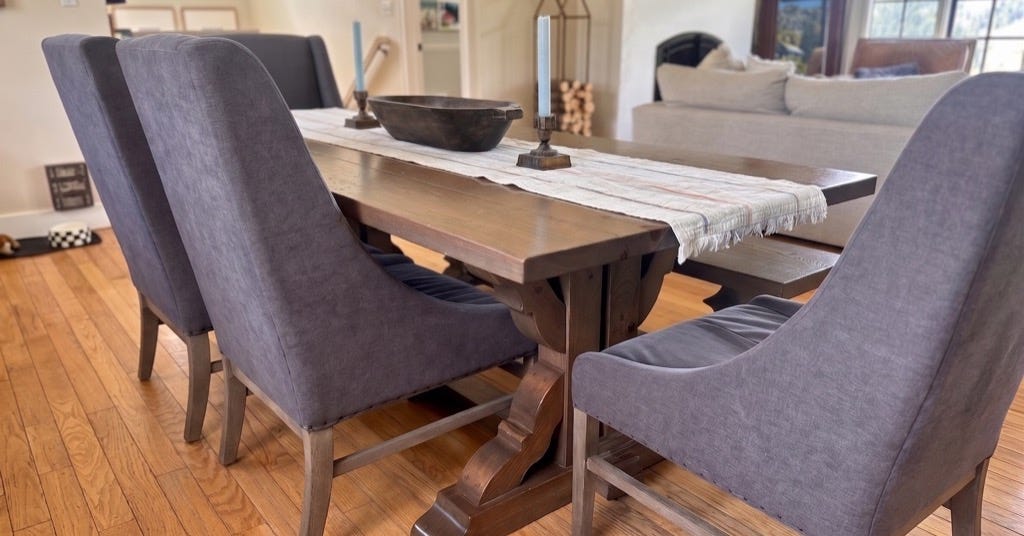
We have a kitchen table a man built in a barn in rural southern Nebraska, thirty minutes off the interstate, in a town not known for anything. It is solid, a little uneven along one edge, and you can see the spot where his hands changed their mind halfway down a leg. By every spec it loses to a machined table. But I was born in Nebraska, my family comes from McCook, a small town down in the south of the state, and every time I sit at that table it comes from my people. The machine could build me a better table. It could not build me that one. Perfect is the spec it wins. Mattering is the purpose it cannot touch.
And the machine is taking perfect somewhere it has never been. Not just the perfect object, but perfect all the way down and all the way up. The perfect word in the perfectly built sentence, in the perfectly shaped paragraph, in the perfectly structured chapter, aimed at the perfectly chosen reader, under the perfectly worded title. It will even perfect itself. Which is exactly why the uneven leg is about to be worth more than it ever has been. When perfect is free and everywhere, the thing with a hand in it becomes the rare and costly thing. Handcrafted used to be the ordinary way to make a table. Now it is the premium. The same word is about to happen to you.
So stop running the race you were handed, and spend yourself where you actually win.
In practice that is almost the opposite of the productivity advice. Let the machine carry what was only ever rote, the formatting, the boilerplate, the forty variations you would never have weighed anyway. But the thinking that forms you, the wrestling that makes you better at the thing, you keep. Hand that over and you go a little more hollow each time, until one day there is no judgment left to add. Then put into the work the part the machine has no way to reach: the reason you care, the story only you carry, the choice a particular mortal person made and stood behind. Make some of it by hand, not to prove the machine can’t, but because you want to be the one who did. Leave the uneven leg. Tell the story with your people in it. Stand out in the open behind the work, where it can be traced back to you.
Make that concrete. Say your work is building presentation decks for clients. The machine builds a better deck than you now, faster, and you both know it. So the deck was never the work. The work is the one slide that lives in no template, the place where you say, I have watched this exact plan fail twice, and here is the version I would put my own name on. That slide costs you something. It has your scars in it. It is the reason they hired a person and not a subscription. Whatever you make, the move is the same: find the part only you can pay for, and put it where it can be seen.
Here is the test, and you can run it on the next thing you make, because performing the real thing is the trap. The uneven leg is already a marketing trick, and the machine will happily counterfeit a little soul for anyone who asks. The test is cost. Performance is free. The real thing always costs the maker something they cannot fake and cannot get back. You can manufacture an imperfection. You cannot manufacture having actually stood there when it might have failed, or actually come from McCook. If what you are making costs you nothing, the machine can already do it. If it costs you something only you can pay, it is yours, and it is the one thing that cannot be taken.
And no, you do not get to sit this out by retreating into the real and letting the rest rush past. I understand the pull, I have watched it cross a lot of faces, the instinct to say I have good years left and I would rather spend them on the garden and the grandkids than on any of this. It is a dignified instinct and it does not work, because stepping out of the way does not keep the machine out of your life. It only means the machine fills the parts of your life you declined to fill yourself. The longer life you are hoping for is going to be handed to you by the very technology you are waving off, the medicine, the help getting around, the help remembering a name. It will be holding your hand at the end whether you made your peace with it or not. The only part you actually get to decide is whether someone is home when it arrives.
None of this is comfortable, and I won't pretend it is. The ground really is moving. The maps we trusted are gone. No one is coming to certify that you chose the right direction. It is, honestly, a little frightening. You walk toward it anyway, because standing still was never the safe option either.
They call AI the last invention, the last thing we will ever need to make. Maybe it is, if inventing only means making new things. But the machine will never once want a single one of them to exist, and that wanting was the real invention all along. Let it have perfect. Spend your one life on what matters. The last real inventor is you.
Knowing what matters from what is merely perfect is wisdom, and wisdom is the heart of your wild intelligence: the authored self the machine can amplify but never replace. WILDiQ is eight minutes to find where yours stands. No cost.
If someone you know is running that race, send them this.